Why Facilities Management Starts Before Design Begins

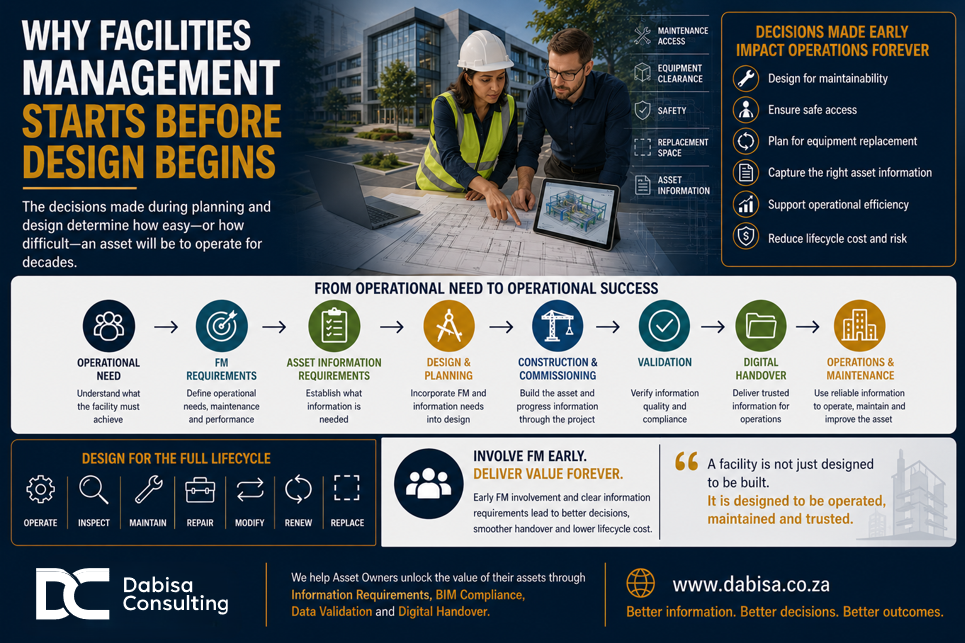
The decisions made during planning and design can determine how easy - or how difficult - an asset will be to operate for decades.
Facilities Management is often viewed as something that begins when a building is completed.
The construction team finishes the project. The keys are handed over. The Facilities Management team takes responsibility. Maintenance requests begin arriving.
But by then, many of the decisions that determine the facility's operational performance have already been made.
The location of plant and equipment.
The accessibility of maintenance areas.
The selection of systems and components.
The identification of maintainable assets.
The availability of replacement space.
The information captured about each asset.
These decisions are made during planning, design and construction.
This leads to an important principle:
Facilities Management does not begin at handover. It begins when the organisation starts defining what the facility needs to achieve.
FM Problems Often Begin During Design
Consider a mechanical plant room.
From a design perspective, the equipment may fit within the allocated space.
The model may coordinate correctly.
The drawings may be approved.
The project may be constructed exactly as designed.
But can a technician actually access the equipment?
Can filters be replaced safely?
Is there sufficient clearance to remove a major component?
Can equipment be transported into the plant room?
Is there adequate space for future replacement?
Are isolation points accessible?
These are not questions that should first be asked when the facility is operational.
They should influence the design.
A technically compliant design is not necessarily an operationally effective design.
The Facilities Manager Needs a Voice Before Construction
Facilities Management teams understand how buildings and infrastructure behave after they are occupied.
They understand maintenance access.
They understand operational constraints.
They know which equipment requires frequent servicing.
They understand the practical consequences of poor space planning.
That knowledge can be extremely valuable during the design process.
Yet FM teams are often brought into the project primarily at handover.
By that stage, changing fundamental design decisions can be expensive - or impossible.
A better approach is to involve operational stakeholders early enough to influence the decisions that will affect the future facility.
Design for Maintainability
One of the most important principles is designing for maintainability.
A facility should not only be designed to be constructed.
It should be designed to be:
Operated
Inspected
Maintained
Repaired
Modified
Renewed
Eventually replaced
This means operational requirements need to influence design decisions.
For example:
Equipment selection
Does the selected equipment have an appropriate maintenance regime and support network?
Accessibility
Can maintenance personnel safely access the equipment?
Spatial planning
Is sufficient space available for maintenance and replacement?
Standardisation
Are similar assets being standardised where practical?
Isolation and safety
Can equipment be safely isolated and maintained?
Replacement
Can major components eventually be removed and replaced without major disruption?
These decisions can have consequences for the facility for decades.
The Same Principle Applies to Information
The physical design is only one part of the equation.
The information required to operate and maintain the facility also needs to be considered before design begins.
The Asset Owner should establish:
What assets need to be managed?
What information will Facilities Management need?
What information must be available at handover?
How should assets be identified?
How should locations and spaces be named?
What information needs to enter the CAFM or asset management system?
How will the information be validated?
These questions should inform the project's information requirements.
This is where the relationship between Facilities Management and BIM becomes particularly important.
The BIM process should not simply produce a geometrically accurate representation of the building.
It should contribute to the creation of trusted asset information that can support operations.
From FM Requirements to Project Requirements
The Asset Owner can translate operational needs into information requirements that flow through the project.
For example:

This creates a direct connection between what Facilities Management needs and what consultants and contractors are required to deliver.
Without this connection, project teams may produce information that is useful for design and construction but insufficient for operations.
Handover Should Not Be the Starting Point
One of the most common mistakes is treating handover as the point at which operational information is collected.
By then, it may be too late.
If asset information requirements have not been established, the project team may have no consistent basis for collecting:
Asset identifiers
Manufacturer information
Serial numbers
Warranty information
Maintenance requirements
Location information
Commissioning information
Replacement information
Trying to reconstruct this information at handover can be expensive and time-consuming.
The better approach is to establish the requirements early and progressively develop the information throughout the project.
Validation Protects the FM Team
Defining requirements is only part of the process.
The Asset Owner also needs confidence that the information delivered actually meets those requirements.
This is where BIM Compliance and Data Validation become important.
Information can be checked at appropriate project milestones rather than waiting until the end.
For example:
Are the required assets included?
Are asset identifiers populated?
Are required parameters complete?
Are locations correctly assigned?
Does the information comply with the agreed standards?
Is the information suitable for operational use?
Early validation allows problems to be corrected while the project team is still working on the asset.
This is considerably more effective than discovering information deficiencies after handover.
FM Should Influence the Project - Not Inherit It
The traditional approach is often:
Design → Construct → Handover → Facilities Management
A more effective approach is:
Operational Requirements → Planning → Design → Construction → Commissioning → Handover → Operations
The difference is significant.
In the first model, Facilities Management inherits the result.
In the second, Facilities Management helps shape the result.
This is a fundamental shift in thinking.
The Asset Owner Has the Critical Role
Ultimately, Facilities Management cannot define the entire project in isolation.
The Asset Owner must establish the organisational objectives and information requirements that connect project delivery with long-term operations.
Consultants and contractors then become responsible for producing the information and physical assets required to meet those expectations.
BIM teams coordinate and manage the information.
Validation processes verify compliance.
Facilities Management uses the resulting information to operate and maintain the facility.
Everyone has a role - but the process starts with the Asset Owner defining what matters.
Conclusion
A facility can be designed to look impressive, constructed to a high standard and handed over with thousands of documents - and still be difficult to operate.
Good Facilities Management therefore begins much earlier than many organisations realise.
It begins when someone asks:
"What will this facility need to perform effectively throughout its lifecycle?"
The answer should influence both the physical design and the information requirements.
Because the decisions made before construction determine many of the operational challenges that appear afterwards.
Don't wait until handover to involve Facilities Management.
Don't wait until operations to discover what information is needed.
Design for the people who will operate and maintain the asset.
And define the information they will need before design begins.
About Dabisa Consulting
At Dabisa Consulting, we help Asset Owners and Infrastructure Authorities connect project delivery with long-term operational requirements through Information Requirements, BIM Compliance, Data Validation and Digital Handover.
Our focus is simple:
Better information. Better decisions. Better outcomes.
Next in the Series
What Are Organisational Information Requirements (OIR)?


Comments