What Are Organisational Information Requirements (OIR)?

Updated: Sep 12

The starting point for ensuring that the information created by projects supports the organisation's long-term objectives.
A common mistake in BIM implementation is to start by asking:
What information should the project team deliver?
A more important question comes first:
What information does our organisation need to make better decisions and manage its assets effectively?
This is the question that Organisational Information Requirements (OIR) are intended to address.
OIR establish the connection between an organisation's strategic objectives and the information it needs to support those objectives.
For Asset Owners and Infrastructure Authorities, this is particularly important because the information created during a capital project may be used for decades after construction is complete.
But if the organisation has not clearly established what information it needs, the project team cannot be expected to deliver information that supports those needs consistently.
OIR Start with the Organisation - not the Model
Consider a university or a hospital developing a new building.
The organisation may have strategic objectives relating to:
Improving the student experience
Reducing operational costs
Improving energy performance
Strengthening safety and compliance
Improving maintenance planning
Managing capital investment
Improving the utilisation of its facilities
These are business objectives.
They are not yet BIM requirements.
The next question is:
What information will the organisation need to support these objectives?
For example:
Organisational Objective | Information Need |
Improve maintenance planning | Reliable asset information and maintenance requirements |
Improve energy performance | Information about energy-consuming systems and their performance |
Strengthen safety and compliance | Information about critical assets, systems and compliance records |
Manage capital investment | Information about asset condition, lifecycle and replacement requirements |
Improve space utilisation | Reliable information about spaces, their use and capacity |
This is where OIR begin to provide value.
They translate what the organisation wants to achieve into what information it needs to support those objectives.
Why OIR Matter to Asset Owners
Without OIR, information requirements can become disconnected from the organisation's actual needs.
A project may produce:
Detailed 3D models
Construction drawings
Equipment schedules
Manufacturer documentation
Commissioning records
Asset registers
But the important question remains:
Does this information support the decisions the organisation needs to make?
A model can be geometrically accurate and still be insufficient for operational use.
A document can be technically correct and still be difficult to use.
A large asset register can still contain information that is incomplete, inconsistent or unreliable.
OIR help establish why the information matters before deciding what information should be delivered.
OIR Are Not Simply a List of BIM Parameters
This distinction is important.
An OIR should not begin with a list such as:
"Every door must have these 15 parameters."
That is a data requirement.
The OIR question is:
What information does the organisation need about its doors, and why?
For example, if the organisation needs to manage access control, it may require information about:
Door identification
Location
Access control system
Associated equipment
Maintenance requirements
Relevant compliance information
The exact information requirements should be determined by the organisational need.
This prevents the common problem of collecting large amounts of data simply because it is available.
The objective is not more information.
The objective is useful information.
From OIR to AIR
OIR establish the organisational need.
The next step is to translate those needs into Asset Information Requirements (AIR).
AIR define the information required to manage the assets.
For example:
OIR: Improve maintenance planning.
↓
AIR: Define the information required for maintainable assets.
↓
This may include:
Asset identifier
Asset classification
Asset location
Manufacturer
Model number
Serial number
Maintenance requirements
Warranty information
Relevant operational information
The important point is that the AIR should be derived from the organisational need.
They should not simply be a collection of parameters that someone believes might be useful.
From OIR to Project Requirements
The information required by the organisation must eventually be communicated to the project team.
This is where the relationship between OIR, AIR and Exchange Information Requirements (EIR) becomes important.
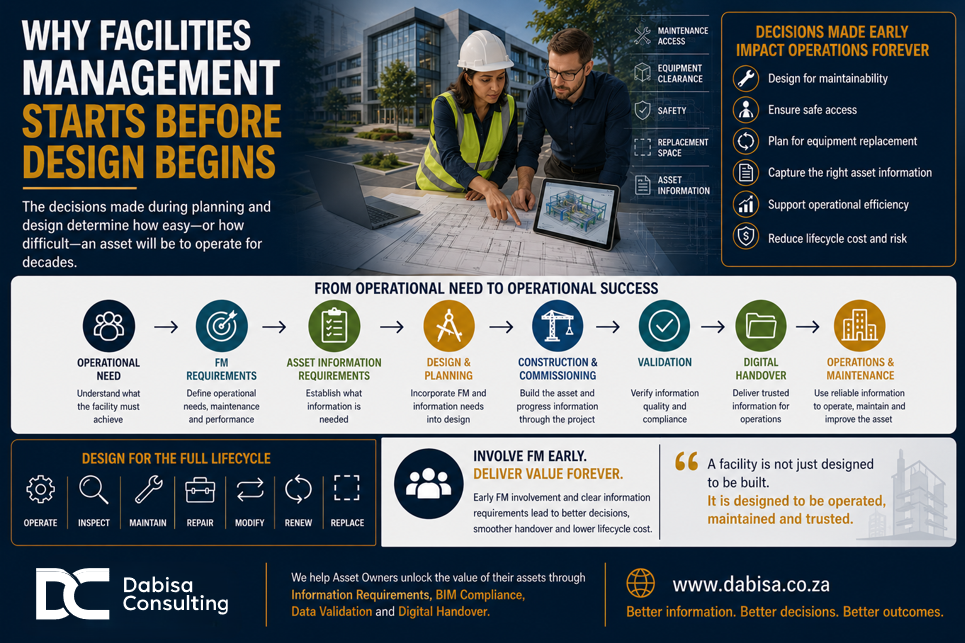
A simplified relationship is:
Organisational Objectives
↓
Organisational Information Requirements
↓
Asset Information Requirements
↓
Exchange Information Requirements
↓
Project Information Deliverables
↓
Validation
↓
Digital Handover
↓
Operations & Asset Management
This creates a much clearer connection between:
What the organisation needs
and
What the project team must deliver.
Without this connection, project information can become focused on the needs of design and construction rather than the needs of the organisation that will ultimately own and operate the asset.
OIR Should Reflect the Asset Lifecycle
One of the most important benefits of OIR is that they encourage the organisation to think beyond the construction project.
The information required during planning may be different from the information required during operations.
For example:
Planning
The organisation may need information to support investment decisions and project prioritisation.
Design
The organisation may need information to evaluate proposed systems, performance and maintainability.
Construction
The organisation may need information to understand what is being installed and how it is being delivered.
Commissioning
The organisation may need information to verify that systems and equipment are ready for operation.
Handover
The organisation may need reliable asset information and documentation for operational use.
Operations
The organisation may need information to support maintenance, compliance, performance monitoring and lifecycle decisions.
OIR help ensure that these needs are considered as part of one connected information strategy.
OIR Are Particularly Important for Infrastructure Authorities
For Infrastructure Authorities, the challenge is often even greater.
They may manage:
Roads
Bridges
Water treatment plants
Water distribution networks
Wastewater infrastructure
Rail infrastructure
Public buildings
Multiple campuses or facilities
Each asset type may require different information.
But the organisation may still need a consistent approach to:
Asset identification
Asset classification
Location
Condition
Maintenance
Performance
Lifecycle planning
Capital investment
OIR provide a way to establish the organisation-wide information needs before developing more detailed requirements for individual asset types or projects.
This is particularly valuable when the organisation manages a portfolio of assets, rather than a single building.
OIR and BIM Compliance
OIR are also important because they provide the foundation for BIM Compliance and Data Validation.
If the organisation has clearly defined what information it needs, then the project team can be assessed against those requirements.
For example:
Organisational Need: Improve maintenance planning.
↓
Information Requirement: Maintainable assets must have reliable identification and maintenance information.
↓
Validation Rule: Required asset information must be populated and conform to the agreed standard.
↓
Operational Outcome: Facilities Management can use the information to support maintenance planning.
This is the difference between:
Checking whether a model contains data
and
Checking whether the information supports the organisation's objectives.
The second is much more valuable.
The Asset Owner's Responsibility
OIR are not simply a BIM Manager's responsibility.
They require input from the organisation.
Asset Owners, Asset Managers, Facilities Management teams, Finance, Operations, IT and other relevant stakeholders may all contribute to defining the information needs.
The BIM team can then help translate those needs into practical information requirements and delivery processes.
Consultants and contractors can produce the information.
Validation processes can verify it.
But the organisation must establish what information matters.
OIR are important because they establish the strategic starting point for information management.
They help organisations move from:
We need BIM.
to:
We need information that supports our organisational objectives.
That is a much stronger foundation.
For Asset Owners and Infrastructure Authorities, the real value of BIM is not simply the production of models.
It is the ability to create trusted information that supports better decisions throughout the asset lifecycle.
And that process begins with a simple question:
What information does our organisation need to achieve its objectives?
That is where Organisational Information Requirements begin.
About Dabisa Consulting
At Dabisa Consulting, we help Asset Owners and Infrastructure Authorities connect organisational objectives with practical information requirements through OIR, AIR, EIR, BIM Compliance, Data Validation and Digital Handover.
Our focus is simple:
Better information. Better decisions. Better outcomes.
Next in the Series
What Are Asset Information Requirements (AIR)?


Comments