IFC 4.3 and the Data Imperative: Why Geometry Is Only Half the Story

How standardized classifications, property sets, and information requirements are transforming infrastructure BIM models into long-term digital assets.
Introduction
For decades, the infrastructure industry has pursued a seemingly simple objective: seamless data exchange between software platforms.
Designers, contractors, and asset owners have all wanted a common format capable of transferring roads, railways, bridges, ports, and utilities between applications without losing information or fidelity.
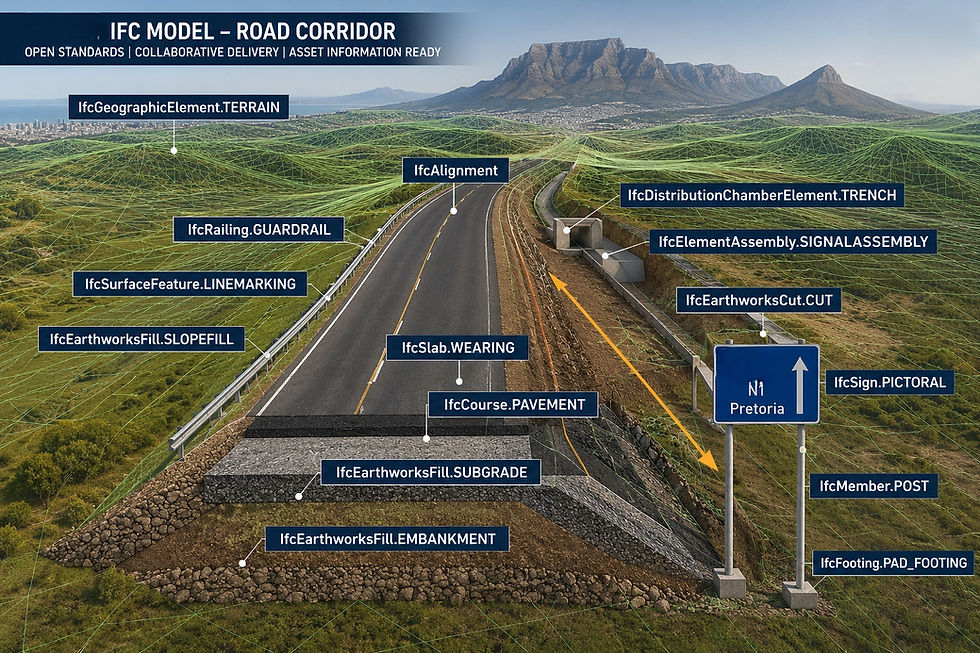
With the release of IFC 4.3, that vision has moved significantly closer to reality. The latest evolution of the Industry Foundation Classes (IFC) standard introduces a robust framework specifically designed for infrastructure projects, supporting roads, railways, bridges, tunnels, marine assets, alignments, and linear referencing.
However, many organisations continue to view IFC primarily as a geometry exchange format.
That perspective overlooks its greatest value.
The true power of IFC 4.3 lies not in the geometry it carries, but in the information attached to that geometry. For owners, operators, and project teams, the real breakthrough comes from standardized classifications, structured property sets, and information requirements that transform BIM models into valuable digital assets.
The Problem with "Naked" Geometry
A beautifully modelled road corridor or railway alignment may look impressive, but geometry alone delivers limited business value.
A model without structured information is like a library without a catalogue. The books are present, but nobody can efficiently search, filter, analyse, or use them.
This challenge appears repeatedly across infrastructure projects.
Manual Re-Entry of Information
Without machine-readable property data, stakeholders often extract information from PDFs, drawings, and spreadsheets before manually entering it into estimating, maintenance, and asset management systems.
This process introduces delays, duplication of effort, and avoidable errors.
Fragmented Asset Handover
Consider a stormwater pipe network.
The pipes may appear correctly in a 3D model, but without attributes such as:
Asset ID
Material Type
Diameter
Installation Date
Design Flow Capacity
Maintenance Responsibility
the model provides little value to an asset management system.
The geometry survives the handover.
The intelligence does not.
Limited Automation and Validation
Modern compliance checking depends on structured information.
Software cannot automatically verify pavement thicknesses, bridge clearances, drainage capacities, or maintenance classifications if those properties are not consistently defined and populated.
As a result, many review and approval processes remain manual, time-consuming, and prone to error.
Moving Beyond Geometry: The Data-Driven Model
IFC 4.3 provides the framework for rich information exchange, but the standard alone does not guarantee quality data.
Project teams must define, manage, and validate the information that populates the model.
Three components are particularly important.
Standardized Classifications
Historically, many organisations identified assets using layers, naming conventions, colours, or project-specific coding systems.
These approaches often break down during project handover because each organisation interprets information differently.
IFC 4.3 enables infrastructure assets to carry recognised classification systems directly within the model.
Examples include:
Uniclass
OmniClass
National infrastructure classification systems
Owner-specific asset taxonomies
This ensures that an embankment, culvert, retaining wall, or railway turnout is consistently understood across software platforms and organisations.
The result is a significant reduction in the "translation tax" that typically occurs when data moves between project participants.
Standardized Property Sets
Classification tells us what an asset is.
Property sets tell us what the asset knows.
Infrastructure assets require consistent definitions for:
Physical dimensions
Materials
Performance criteria
Design parameters
Operational characteristics
Maintenance requirements
Lifecycle information
When organisations establish standardized property sets for roads, rail assets, drainage networks, bridges, and utilities, IFC models become structured databases rather than static geometric representations.
This consistency is especially important when models are exported from multiple authoring platforms and consumed by downstream systems such as GIS, CMMS, EAM, and Digital Twin environments.
Information Delivery Specifications (IDS)
One of the most significant developments accompanying IFC adoption is the growing use of Information Delivery Specifications (IDS).
IDS allows owners and project teams to define exactly what information must be delivered for each asset type.
Instead of requesting a generic IFC model, owners can specify:
Required classifications
Mandatory property sets
Required attributes
Accepted values
Validation rules
Asset Information Requirements (AIR)
This transforms project delivery from a file-based process into an information-based process.
The focus shifts from simply delivering models to delivering verified, usable asset information.
The Business Value of Data-Rich IFC Models
When IFC 4.3 is combined with standardized classifications, property sets, and information requirements, infrastructure workflows change fundamentally.
Automated Quantity Take-Offs
Quantity surveyors can rely on the model as a trusted source of information.
Standardized object definitions and properties enable accurate automated measurement and reporting, reducing dependence on manual interpretation of drawings.
Automated Model Validation
Model validation platforms can automatically verify compliance against project standards and regulatory requirements.
This enables project teams to identify issues earlier and reduce costly rework during construction.
Digital Twin Readiness
A data-rich IFC model provides the foundation for Digital Twin initiatives.
The model becomes a structured repository of asset information capable of supporting:
Maintenance planning
Lifecycle costing
Operational analytics
Asset performance monitoring
Predictive maintenance
Instead of rebuilding asset registers after construction, owners inherit validated information from day one.
Streamlined Regulatory Approvals
Public agencies and infrastructure authorities can increasingly automate design reviews by interrogating model data directly.
Rather than manually inspecting drawings, reviewers can verify compliance using predefined rules and structured asset information.
This improves consistency, reduces review times, and increases confidence in project submissions.
What This Means for Asset Owners
For infrastructure owners, IFC 4.3 represents much more than an interoperability standard.
It provides an opportunity to establish a consistent information framework that extends across the entire asset lifecycle.
When properly implemented, the benefits include:
Better asset visibility
Improved maintenance planning
Reduced handover costs
Higher quality asset data
Faster regulatory approvals
Stronger Digital Twin foundations
Improved long-term return on information investments
The organisations that define their classifications, property sets, Asset Information Requirements (AIR), and Information Delivery Specifications (IDS) early in the project lifecycle will extract significantly more value from their BIM investments.
Conclusion: From Models to Information Assets
For many infrastructure professionals, success has traditionally been measured by geometric accuracy and visual quality.
Those qualities remain important.
However, IFC 4.3 requires a broader perspective.
The question is no longer:
"What does this model look like?"
The more important question is:
"What does this model know?"
The organisations that gain the greatest value from IFC 4.3 will be those that treat information as a strategic asset. By standardizing classifications, property sets, Asset Information Requirements, and Information Delivery Specifications from the outset, they create models that continue delivering value long after construction is complete.
In this future, infrastructure owners are no longer receiving drawings or even models.
They are receiving structured, validated, and operationally useful information.
And that information may ultimately prove more valuable than the geometry itself.


Comments